


Stories today move through more than one place before reaching an audience. They are picked up, adapted, and shared across newsrooms, platforms, and creators, often in ways that are not fully controlled by the original publisher.
In an exclusive interview for Yoof News, Joanna Webster, Global Editor for Agency News Strategy at Reuters, explains how that shift is reshaping the role of organisations like Reuters. After nearly two decades at the company, she now sits at the intersection of editorial, product, and commercial, working closely with clients to understand what they need from news, and how Reuters can deliver it.
Across the conversation, she touches on what makes a story usable for other newsrooms, why trust and verification remain central in an environment shaped by AI, and how creators are influencing the way journalism is produced and distributed.
Can you tell us a bit about your role at Reuters?
I’m a Global Editor for Agency News Strategy. I’ve been at Reuters for nearly 17 years now and It’s been fascinating to see how the organisation has evolved. If I were to summarise my current job, I would say that I am the connective tissue between our newsroom and commercial team, our product teams and our clients. I ensure that I understand our clients’ strategies, to enable us to combine them with the journalism and content services that they need- not just now, but in the future.
How has the news environment changed since you joined Reuters?
If you look back a couple of decades, news was relatively linear. Now, stories are multidirectional and continuous, they can enter an ecosystem at multiple points. Stories can ping between wires, professional newsrooms, platforms, messaging apps, creators, and communities. What has significantly changed is how many hands a story passes through and how it reaches an audience. What hasn’t changed is speed- speed is still paramount.
Reuters has also evolved over that period. We started as a wire service but now we’re a global organisation that combines the fastest, most accurate wire service with deep reporting, visual journalism, verification, and a big publishing arm. We’re not just an agency, we’re also a publisher, we know that discoverability matters as much as distribution. If our journalism isn’t surfacing at the right moment, in the right API, on the right platform, it may as well not exist.
What makes a newsroom pick up a story?
Before you get to how a story is presented, it’s fundamentally about trust. It’s about trusting the brand in its journalism, standards, and verification. To pick a story up, for example, on YouTube, you have to be confident in the journalism- that it’s accurate, unbiased, and verified. Beyond that, it’s about whether the journalism is extraordinary or exciting- whether it can connect with an audience and move a story forward. At Reuters, our goal is to make our journalism indispensable, something that you cannot live without. In terms of editorial, it’s about the quality of editing. Will one editor instantly know what it is? Is the structure easy to exert, adapt, or repackage? Do the visuals explain the story? In terms of the product, it’s about strong metadata and tagging, helping stories surface at the right moment.
Is there an expectation for news content to be adapted to social media?
At a very basic level, newsrooms expect raw materials to be adaptable across formats. They expect assets that are respectful of platform norms without surrendering editorial standards. There’s an increasing expectation of vertical video, captions, and strong thumbnails. It fundamentally comes down to the building blocks that clients need for whatever platform they’re producing for, and to provide all of those jigsaw pieces. In addition to content, Reuters is also focusing on building tools that make it fast and easy for our clients to produce content in the formats they need. We have to be very flexible and adapt quickly to changing trends so that our content can be used by all of our customers on different platforms. It’s really about meeting the audience where they are.
Do audiences expect more visuals? How does this impact the way a story travels?
Visuals and videos can often be an entry point into a story or the most effective medium to tell it. In crowded environments, stronger visuals can really help stories travel across platforms, language, cultural and literacy barriers, and ultimately reach wider audiences. Take the photo of Andrew Mountbatten Windsor slumped in the back of the car shot by Reuters as an example.
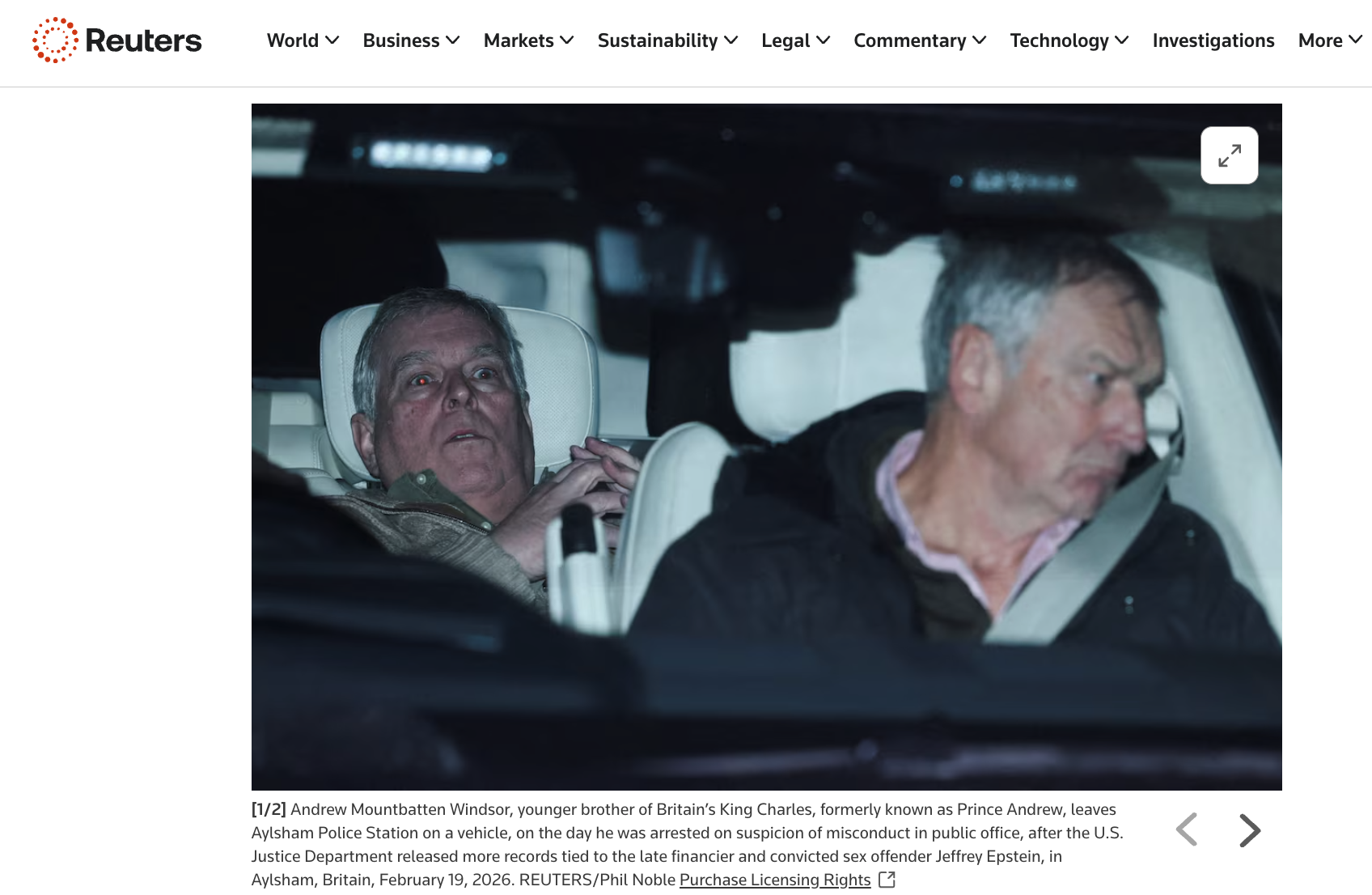
Our clients told us that they saw a spike in traffic when that photo hit their website. It went viral and became the subject of talk shows, news columns, and dinner party conversations. So, when you look at the reach of a very strong visual, it can engage an audience emotionally and immediately, improving the speed of understanding and the strength of a story.
That being said, editorial judgement always comes first. A visual’s original appeal would never override accuracy or balance for Reuters. A strong visual can certainly influence how we tell a story and how we distribute it, but we always use our editorial judgement to decide whether the story is journalistically sound or not.
How has AI had an impact on accuracy in the news?
This is a huge area for concern. Even in the past month, we have seen a proliferation of AI generated video content purporting to show strikes relating to the Iran crisis. Last month, we had a spike in AI generated video purporting to show Nicholas Maduro being captured and in court.
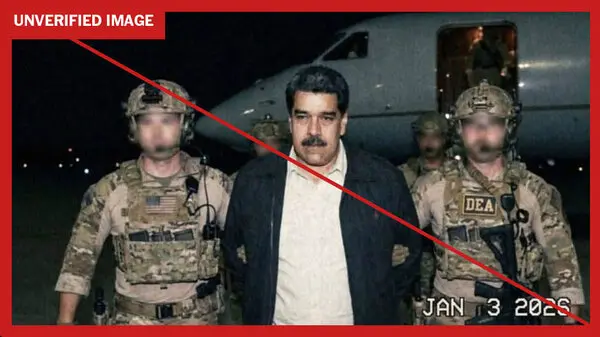
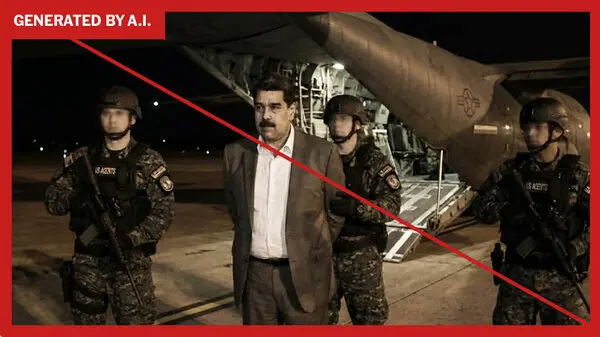
At Reuters, we have a 24/7 open source intelligence team that we have been building for over a decade who are experts in their fields. We trust our boots on the ground and journalists that are witnessing things in more than 200 locations around the world, but we can’t be everywhere at once. The verification team uses a variety of techniques, from reverse image search, to using satellite imagery and corroborating visuals, to speaking to the source, to finding the metadata and looking at terrain. They also use AI spotting tools- though none are silver bullets. All of that together, plus their experience, allows us to do everything we can to verify content. Ultimately, if we’re not confident, we don’t publish it. When we do publish, we are also transparent about what we don’t know.
As we see more and more misinformation and disinformation infiltrating the news ecosystem, audiences will want to ensure that what they are consuming is accurate. Reuters, and other organisations like it, will play an absolutely critical role in this in the coming years.
What is your perspective on news creators?
This is a big shift happening across the news ecosystem. Creators are amazing, many of them are amazing journalists. They have shortened feedback loops and been able to accelerate story amplification. They have expanded where journalism shows up and can reach younger or different audiences. Many of them excel at narrative, audience connection, and speed of interpretation. I think they’re actually great teachers for the so-called legacy organisations, and we can learn a huge amount from them. Legacy organisations are sometimes accused of being a bit tone deaf to some communities, so I think we can learn from them and they can be a great partner to us.
Trust is a key value for a news creator. You can’t have a relationship with your audience without a high level of trust, and you can’t have trust if you don’t present facts accurately. You need to present them in a way that resonates with your audience, but if you’re wrong in the facts you can quickly lose their trust. For Reuters, this is an opportunity to provide the facts and be the foundation of that trusted relationship. A creator will know their audience far better than Reuters would, but Reuters is on the ground all over the world and can bring facts to those creators.
Do you think creators are producing original stories or repackaging information already in the news?
I think good news creators heavily monitor platforms, livestreams, visuals, and trending posts that give them an entry point or alert in a story. They likely look at traditional media and wires to confirm facts or verify them. However, I know that many of them have their own direct sources. They do original reporting and investigations, they conduct interviews and can often unlock relationships with politicians or different newsmakers, providing a different type of environment which can unlock interesting revelations. Many creators are ex-legacy journalists themselves. I think the challenge for creators can be that they don’t always have the scale as a one man band or small team to do this. This comes back to being able to make sure they are legally compliant and maintaining authenticity and trust with their audiences. They need to make sure that they are not spreading false information.
Creators can reshape stories. Many creators can come from a particular standpoint or persuasion, where they might be on one side of the story or another- that might give them access to a particular politician. They might be very commentary, trying to fill the gaps left by traditional media, or they sometimes double down on explanations to make news more accessible. Then you have news-adjacent creators who can influence public debate through satire, comedy, entertainment, and lifestyle. It comes back to having that foundation- many of them have the resources and can do their reporting but it becomes difficult to do that at scale.
Do you think the rise of independent journalism will change the news travels in the next 10 years?
I certainly think news creators are going to keep us on our toes. They are going to teach us new ways of reaching audiences. I think information and news is going to become more disintermediating. I do think that there is going to be more independence rather than any level of replacement. If I was to describe it in a very simplistic way, I would look at agencies as a trusted factor of quality journalism with reporting and robust standards. News moves in a very fragmented way, and it will be fascinating to see how it evolves, especially in the age of AI.
So what?
What Joanna Webster describes points to a shift in where value sits in the news ecosystem. It is no longer only in publishing the story, but in making it usable by others.
Stories now move through multiple hands. For them to travel, they need to be clear, structured, and easy to adapt. That is where organisations like Reuters position themselves, as providers of the building blocks others rely on, from verified facts to visuals, metadata, and formats that work across platforms.
Speed still matters, but it sits alongside other requirements. Content needs to be accurate, immediately understandable, and ready to be repackaged without losing meaning. In an environment where AI-generated content is becoming more common, verification becomes part of that value.
Creators play a role in how stories gain momentum. They shape narratives, connect with audiences, and extend distribution. At the same time, they depend on trusted sources to ground their reporting. Each side contributes to how stories evolve and reach scale.
In a fragmented ecosystem, the organisations that matter are the ones whose content continues to move.